


Inverter – FRONIUS – Verto 33.3 SPD 1+2
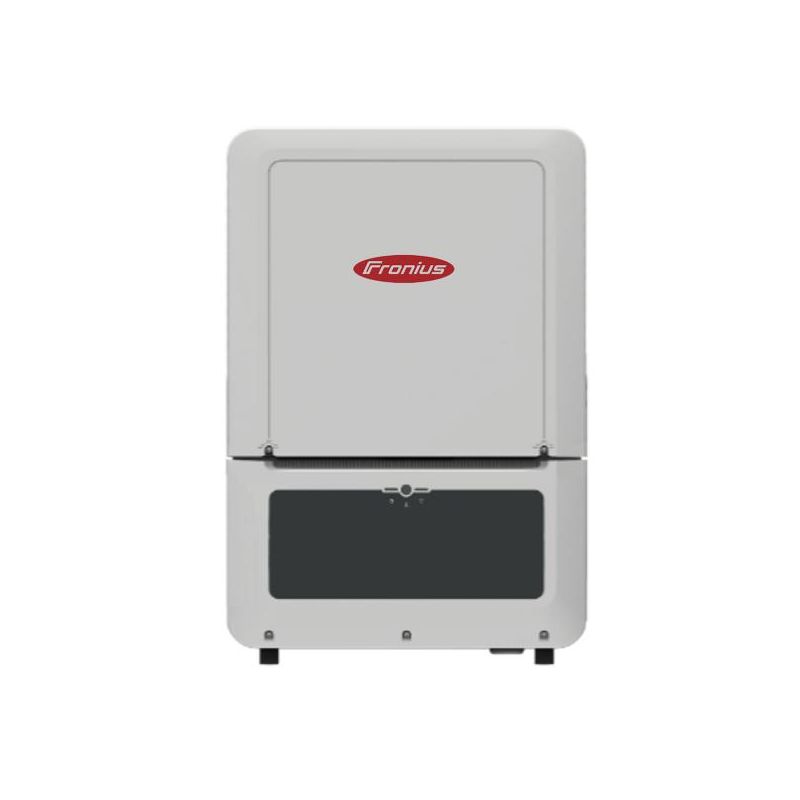
Product details
Verto
Verto is a series of Fronius three-phase photovoltaic inverters with a rated AC output of 25–33.3 kW, depending on the model. Four MPP trackers facilitate the design of complex systems, while the integrated Dynamic Peak Manager algorithm optimizes yields even under shading. Open interfaces enable surplus energy to be used for electric vehicle charging and heating.
Key advantages of Verto
- Four MPP trackers: maximum usable current of 28 A per MPPT, two DC connections per MPPT and a DC input voltage range of 150–1000 V.
- Dynamic Peak Manager: integrated algorithm that optimizes energy yields when the installation is shaded.
- Integrated protection: Arc Guard electric arc detection and interruption, DC/AC surge protection and reverse polarity protection.
- Efficiency: maximum efficiency of 97.47–98.03%, depending on the model, and MPP efficiency above 99.9%.
- Energy management integration: compatibility with Fronius Wattpilot and Fronius Ohmpilot, plus the option to integrate heat pumps and smart home systems; WiFi connectivity, Ethernet LAN and two RS485 interfaces.
- Indoor and outdoor installation: IP66 protection rating, active air cooling and an ambient temperature range of −40 to +60 °C.
Who is this a good choice for?
Verto is designed for small businesses, farms and multi-family homes building a new PV system or expanding an existing one. Four MPP trackers meet the needs of complex systems, while open interfaces allow users to link energy production with heating and electromobility. For companies with an electric vehicle fleet, the Fronius EMIL software solution enables automatic management of fleet charging across the entire site.
| Parameter | Verto 25.0 | Verto 27.0 | Verto 30.0 | Verto 33.3 |
|---|---|---|---|---|
| DC input data | ||||
| Number of MPP trackers | 4 | |||
| Number of DC connections per MPPT | 2 | |||
| Maximum usable input current per MPPT (A) | 28 | |||
| Maximum usable input current per string (A) | 28 | |||
| Maximum PV generator short-circuit current per MPPT (A) | 50 | |||
| Maximum PV generator short-circuit current per string (A) | 50 | |||
| Maximum PV generator short-circuit current per inverter (A) | 150 | |||
| Rated input voltage (V) | 600 | |||
| DC input voltage range (V) | 150–1000 | |||
| Start-up voltage (V) | 150 | |||
| Usable MPP voltage range (V) | 150–870 | |||
| MPP voltage range at rated power (V) | 300–870 | 330–870 | 360–870 | 400–870 |
| Maximum usable DC power per MPPT (Wpeak) | 13,000 | |||
| Maximum PV array power per MPPT (Wpeak) | 20,000 | |||
| Maximum PV generator power per inverter (Wpeak) | 37,500 | 40,500 | 45,000 | 50,000 |
| AC output data | ||||
| Rated AC power (W) | 25,000 | 27,000 | 29,990 | 33,300 |
| Maximum output power (VA) | 25,000 | 27,000 | 29,990 | 33,300 |
| AC output current at 380 V (A) | 37,9 | 40,9 | 45,5 | 50,5 |
| AC output current at 400 V (A) | 36,2 | 39,1 | 43,5 | 48,3 |
| AC output current at 440 V (A) | 32,8 | 35,4 | 39,4 | 43,7 |
| AC output current at 480 V (A) | 30,1 | 32,5 | 36,1 | 40,1 |
| Grid connection (V) | 3~ (N)PE 380/220; 3~ (N)PE 400/230; 3~ (N)PE 440/254; 3~ (N)PE 480/274 | 3~ (N)PE 380/220; 3~ (N)PE 400/230; 3~ (N)PE 440/254; 3~ (N)PE 480/275 | 3~ (N)PE 380/220; 3~ (N)PE 400/230; 3~ (N)PE 440/254; 3~ (N)PE 480/276 | 3~ (N)PE 380/220; 3~ (N)PE 400/230; 3~ (N)PE 440/254; 3~ (N)PE 480/277 |
| Rated frequency and frequency range (Hz) | 50/60 (45–65) | |||
| Total harmonic distortion (%) | < 3 | < 1 | ||
| Power factor | 0–1 ind./cap. | |||
| Efficiency | ||||
| Maximum efficiency (%) | 97,47 | 98,03 | 98,02 | 97,98 |
| European efficiency (%) | 97,36 | 97,79 | 97,80 | 97,76 |
| MPP efficiency (%) | > 99,9 | |||
| Dimensions and weight | ||||
| Dimensions: height × width × depth (mm) | 865 x 574 x 279 | |||
| Inverter weight (kg) | 41,75 | |||
| Operating conditions | ||||
| Degree of protection | IP 66 | |||
| Protection class | 1 | |||
| DC/AC overvoltage category | 2/3 | |||
| Nighttime power consumption (W) | < 16 | |||
| Cooling | Active air cooling | |||
| Installation | Indoor and outdoor installation | |||
| Ambient temperature range (°C) | from -40 to +60 | |||
| Permissible air humidity (%) | 0–100 | |||
| Noise emission (dB(A)) | < 54,6 | |||
| Maximum altitude above sea level (m) | 3000 / 4000 (unrestricted / restricted voltage range) | |||
| Connection technology | ||||
| AC | ||||
| AC conductor cross-section (mm²) | 4–35 | |||
| AC conductor material | Al and Cu | |||
| Cable gland | AC: M32 (Ø12–24.5 mm) Prepared for Option 1: M50 cable gland (Ø10–35 mm) Option 2: 1.5" conduit connection PE and data transmission: 2 × M32 (3×Ø4.9–5.5 mm + 3×Ø6.7–8.5 mm) | |||
| DC | ||||
| DC connection terminals | Direct DC connection Stäubli Multi Contact MC4 | |||
| DC conductor material | Al and Cu | |||
| Protection | ||||
| DC insulation | Integrated | |||
| DC disconnector | Integrated | |||
| Residual current monitoring unit (RCMU) | Integrated | |||
| Electric arc detection and interruption – Arc Guard | Integrated | |||
| Reverse polarity protection | Integrated | |||
| DC/AC surge protection | Type 1+2 or type 2 | |||
| Interfaces | ||||
| WiFi | Fronius Solar.web, Modbus TCP, JSON, 802.11b/g | |||
| Ethernet LAN RJ45 | 10/100 Mbit; max. 100 m Fronius Solar.web, Modbus TCP, JSON | |||
| Wired shutdown (WSD) | Integrated | |||
| 2 × RS485 | Modbus RTU SunSpec (third-party) / Fronius Smart Meter | |||
| 6 digital inputs | Programmable remote control receiver interface, energy management, load management | |||
| 6 digital inputs/outputs | Programmable remote control receiver interface, energy management, load management | |||
| Communication card and web server | Integrated | |||
| Certificates | ||||
| Certifications held and standards met | IEC62109-1/-2; VDE-AR-N 4105:2018; R25; UNE 217002:2020; IEC 62116; EN 50549-1/-2; AS/NZS 4777.2:2020+A1; IEC 63027:2023; CEI 0-21; CEI 0-16 | |||
A single string can handle the full usable MPPT current; the maximum current per MPPT is limited to 28 A. Short-circuit current: Isc pv = Isc max ≥ Isc (STC) × 1.25, in accordance with IEC 60364-7-712, NEC 2020 and AS/NZS 5033:2021.
Official distribution