


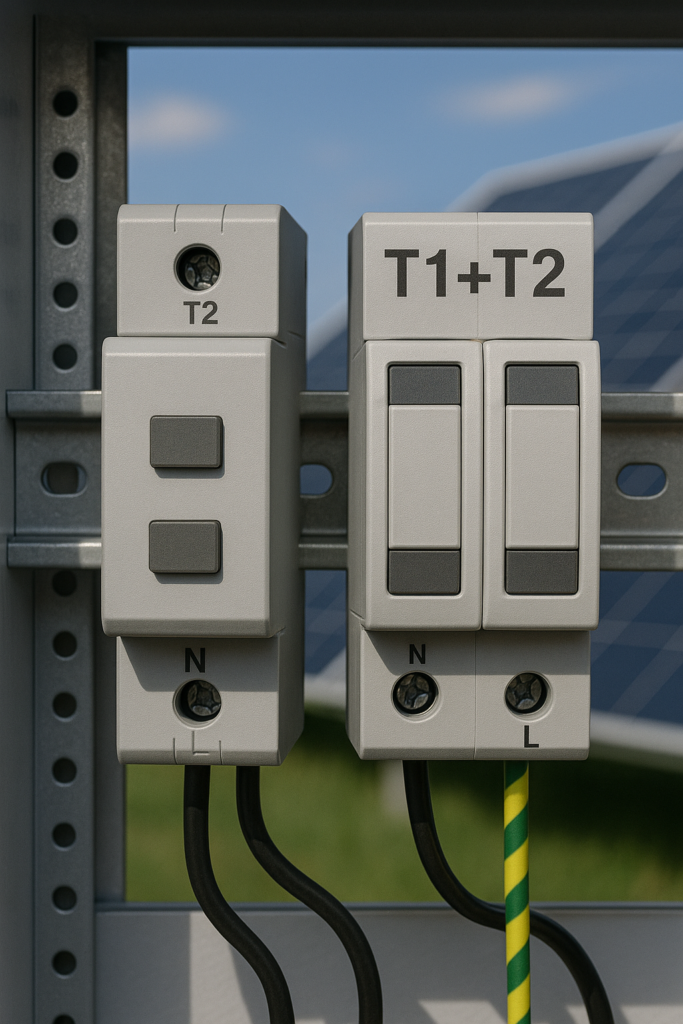
Selecting the right surge protection is key to the safety and durability of a photovoltaic installation. Even the best inverter or panels are not immune to the effects of surges caused by atmospheric discharges or switching events.
Therefore, in addition to the SPDs themselves, proper grounding is just as important – both the type and the cross-section of the conductors matter.
When to use Type T2 SPDs
T2 (Type 2) surge protective devices are installed in systems without the risk of a direct lightning strike, i.e. when:
- the building does not have a lightning protection system (LPS),
- the roof is made of a non-conductive material (e.g., ceramic tiles, roofing felt/bitumen, shingles, slate),
- the PV structure is not connected to the lightning grounding system.
In this case, T2 protection safeguards against indirect and induced surges, which can occur when lightning strikes near the building or the power grid.
When to use Type T1+T2 SPDs
T1+T2 surge protective devices are required wherever there is a risk of a direct lightning discharge, i.e. when:
- the site has a lightning protection system,
- the PV structure is metallically (galvanically) connected to the LPS or to earth,
- the roof is metal (trapezoidal sheet, metal roof tiles) and forms a connection with the PV structure,
- the DC cables run closer than 0.5 m to lightning protection components.
T1+T2 protects against the effects of direct and indirect discharges, which is why it is used on both the DC and AC sides.
Practical rule:
If a T1+T2 SPD is used on the roof, then a T1+T2 should also be installed in the AC distribution board to maintain coordination of protection on both sides of the inverter.
Repeating SPDs on long strings
If the distance between the PV modules and the inverter exceeds 10 m, the DC SPDs should be repeated at the beginning and end of the string:
- one set near the panels (in a PV string box),
- the second near the inverter.
This way, surge energy is effectively dissipated, and the DC cables and devices are protected along the entire route.
Choosing the cross-section of grounding conductors – 6 mm² or 16 mm²?
The effectiveness of SPDs depends not only on their type, but also on proper grounding. A grounding conductor that is too thin may not carry away the impulse energy, and one that is too long or poorly routed will increase the impedance of the protective path.
6 mm² Cu stranded conductor
Used in installations without an LPS (lightning protection system), i.e. where:
- the risk of a direct discharge is low,
- Type T2 SPDs are used,
- grounding conductors have short runs (up to a few metres),
- the PV structure is connected to a local earth electrode or the main PE equipotential bonding bar.
Example: an installation on a single-family home with a tiled roof and no lightning protection – a 6 mm² Cu conductor is sufficient.
16 mm² Cu stranded conductor
Used in installations with an LPS or where:
- the PV structure is connected to lightning protection components,
- Type T1 or T1+T2 SPDs are used,
- the building has a metal roof or a steel structure,
- there is a possibility that part of the lightning current may flow.
Example: a hall with a trapezoidal sheet metal roof and a lightning protection system – a 16 mm² Cu conductor as the connection between the PV structure and the earth electrode is mandatory.
Good grounding practices
- Route grounding conductors along the shortest and straightest path, avoiding loops and sharp bends.
- Make connections permanent and corrosion-resistant – preferably with stainless clamps or brazed/welded joints.
- Ensure that DC, AC and PV structure grounding are connected together and share a common potential reference point (Main Earthing Bar – GSU).
Summary
| Element | Building/roof type | Recommended SPD | Grounding cross-section |
|---|---|---|---|
| Single-family home without LPS, roof with tiles/felt/shingles | Non-conductive roof | T2 (DC and AC) | 6 mm² Cu |
| Building with an LPS or a metal roof | Conductive roof / LPS | T1+T2 (DC and AC) | 16 mm² Cu |
| Module–inverter distance > 10 m | Long string | Repeated DC SPDs | As above (depending on LPS) |
To sum up:
Surge protection for a PV installation works effectively only when it is comprehensive, coordinated, and properly grounded.
In the 7SUN.eu offer you will find complete AC/DC protection sets (T2 and T1+T2), PV connection boxes with ready-made grounding, and Cu conductors 6 mm² and 16 mm², compliant with PN-HD 60364-7-712 and EN 61643-32.
