


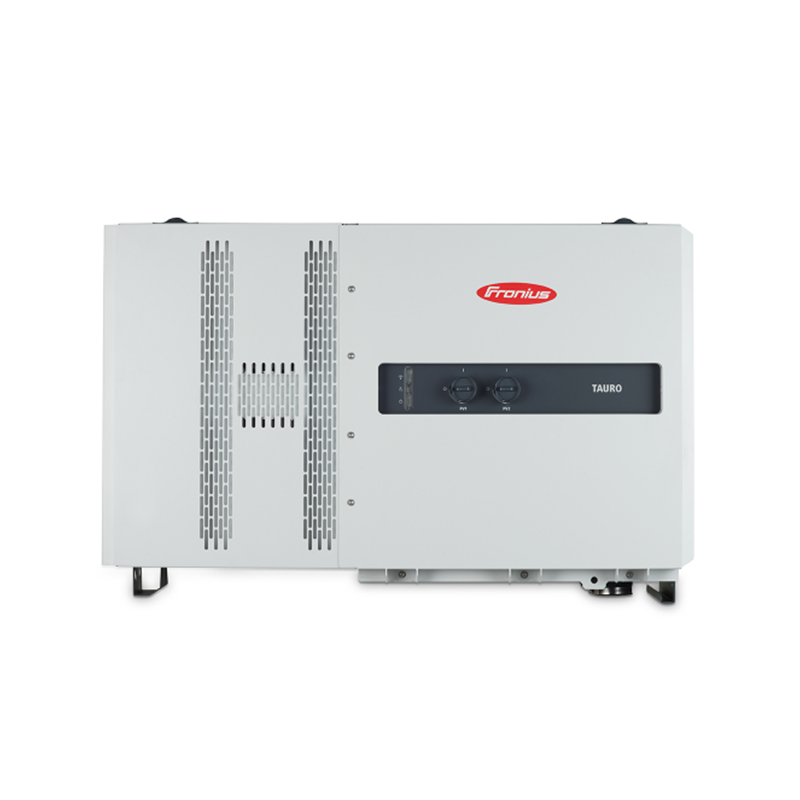
Inverter – FRONIUS – Tauro ECO 50-3-D
Product details
Tauro
Tauro by Fronius is an inverter designed for large photovoltaic installations. The double-walled housing and active cooling enable operation in direct sunlight and at high temperatures. The design allows individual power modules to be replaced instead of the entire unit, making servicing easier and reducing its costs.
Key benefits of Tauro
- Resistance to sunlight and high temperatures: double-walled housing and active cooling help maintain full power.
- Flexible installation: option for central or peripheral placement and installation in a vertical or horizontal position.
- Monitoring via Fronius Solar.web: control of the installation from a smartphone or computer.
- Open system: option to integrate third-party components and communicate via Modbus TCP SunSpec, Modbus RTU SunSpec and Fronius Solar API.
- On-site service: replacing a single power module without having to replace the entire inverter saves time and money.
- Fewer additional components and less wiring: integrated surge protection and daisy-chaining on the AC side reduce the need for additional installation components.
Who is this a good choice for?
Tauro is a solution for owners of large photovoltaic installations who want to monitor system performance and reduce servicing costs. It is well suited to locations where the inverter is exposed to direct sunlight and high temperatures, and the project requires flexibility in choosing the installation location and mounting orientation.
| Parameter | Tauro 50-3-D | Tauro ECO 50-3-D | Tauro ECO 99-3-D | Tauro ECO 100-3-D |
|---|---|---|---|---|
| DC input data | ||||
| Number of MPP trackers | 3 | 1 | ||
| Maximum input current (A) | 134 | 87,5 | 175 | |
| Maximum string input current — 20 A option (A) | 14,5 | |||
| Maximum string input current — 30 A option (A) | 22 | |||
| Maximum string short-circuit current — 20 A option (A) | 20 | |||
| Maximum string short-circuit current — 30 A option (A) | 30 | |||
| Maximum inverter short-circuit current (A) | ||||
| AC output data | ||||
| Power (kW) | 50 | 99,99 | 100 | |
| Protection | ||||
| DC disconnector | Integrated | |||
| Behavior under overload | Operating point shift, power limiter | |||
| Residual current monitoring (RCMU) | Integrated | |||
| DC insulation measurement | Integrated | |||
| AFCI arc fault detection (Fronius Arc Guard) | — | Integrated (only for the 20 A option) | ||
| DC/AC surge protection | Type 1 + 2 integrated⁶, type 2 optional | |||
| String protection with fuses | Integrated, 20 A or 30 A | |||
| Interfaces | ||||
| Wi-Fi | Fronius Solar.web, Modbus TCP Sunspec, Fronius Solar API (JSON) | |||
| Ethernet LAN RJ45 | 10/100 Mbit; max. 100 m | |||
| USB (Type A socket) | 1 A @ 5 V max.⁷ | |||
| Wired shutdown (WSD) | Emergency stop switch | |||
| 2 × RS485 | Modbus RTU SunSpec | |||
| 6 digital inputs | Programmable remote control receiver interface, energy management, load control | |||
| 6 digital inputs/outputs | ||||
| Data logger and web server | Integrated | |||
USB is used exclusively for power supply. Communication between inverters takes place via Ethernet in a star topology. Each inverter connects to the network independently via an integrated data logger.
Official distribution